
- Home
- Urban projects
Urban projects
The territory of the Brussels-Capital Region is constantly developing. Learn more about our urban projects (French or Dutch)
- Urban issues
Urban issues
Housing, facilities, economy, land... perspective.brussels collects and analyses the data essential to the development strategy of the Region. Learn more about these urban issues (French or Dutch)
- Statistics and analyses
- Planning tools
- Who are we?
The territorial and spatial dimension: a prerequisite for a successful transition to a circular economy?
Contribution on the future Circular Economy Act
Posted on 15 December 2025
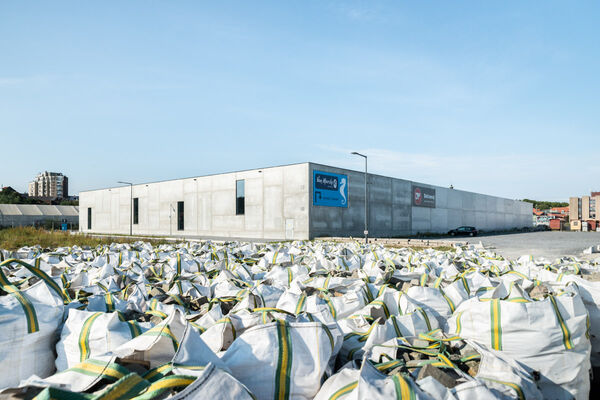
© perspective.brussels/Pedro Correa
Strengthening the European market for waste and secondary raw materials in order to accelerate the transition to a less dependent, more competitive and more decarbonised economy: this is the objective of the European Union's Circular Economy Act, expected in 2026.
Before drafting this future text, the European Commission launched a public consultation with the relevant stakeholders. In this context, Perspective wanted to highlight an angle that is still underrepresented in the discussions: the territorial and spatial dimension of the transition to a circular economy.
Why does it matter? Because space is not just a medium, but a strategic resource. It is in the territories that circularity takes shape, is structured and creates value. And to recycle and recover secondary materials, you need space! But you also need to minimise the distance travelled by material flows, which is why urban areas are well placed to play a leading role in the development of the circular economy. Without integrating urban and territorial issues, European ambitions risk remaining theoretical.
Perspective calls on the Commission to fully integrate spatial planning into the future legislative act and recommends that it:
- Integrates the territorial and multi-scale approach to the circular economy to ensure consistency between economic needs, environmental constraints and quality of life at different scales.
- Develops new forms of circular industrial production in cities that are integrated and compatible with their environment, based on innovation and organised in harmony with other urban functions.
- Encourages the reuse of buildings, materials and spaces rather than demolishing, rebuilding and consuming new land.
- Goes beyond critical raw materials and considers the flows of construction materials, biomass, infrastructure and consumer goods.
- Promotes circularity from design through to end of life, prioritising reuse and repair over recycling alone.
- Involves and recognises the major role played by territorial actors and reinforces the coherence between different European legislation with a spatial impact.
Perspective invites the Commission to involve spatial planning actors in future discussions and the development of the Circular Economy Act, and to support regional, urban and transnational initiatives that are already experimenting with new forms of circularity.


